
Passeig de Gràcia metro station
Line 2, Line 3 and Line 4 · Zone 1 · l’Eixample
Passeig de Gràcia station
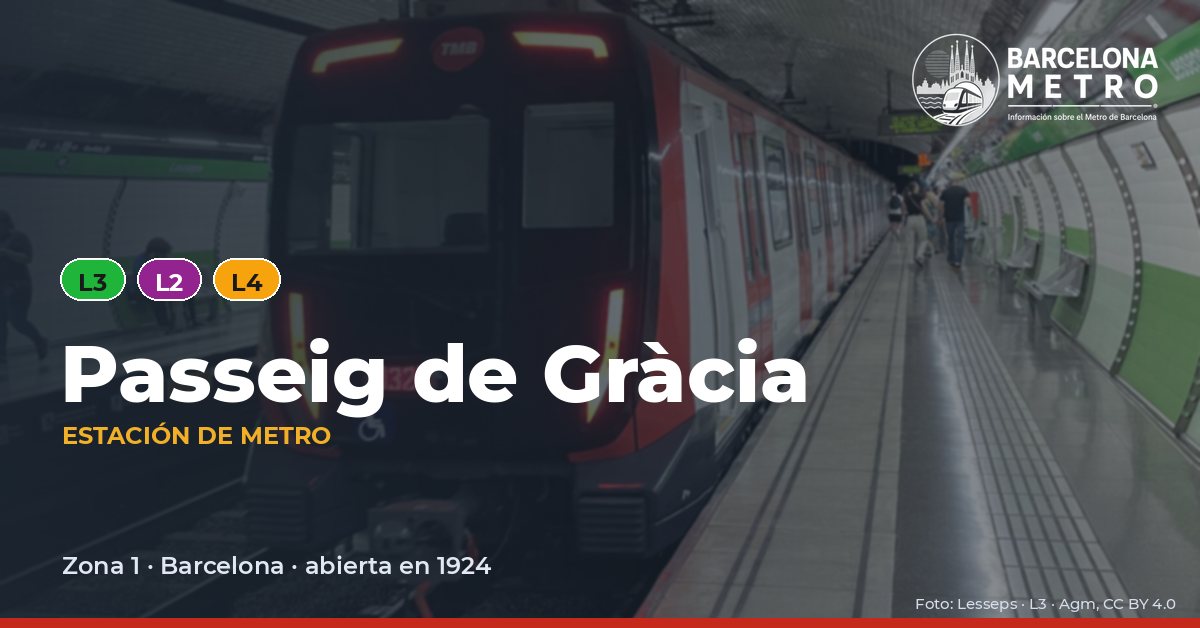
The story begins on 30 December 1924, when Barcelona’s first metro line opened – today’s Line 3 – with a station called Aragón, after its closeness to the junction of Passeig de Gràcia and that street. A branch also ran from Aragón to what is now Jaume I. In 1972 that branch of what was then Line III was closed, and it reopened as a separate line, with new platforms, in February 1973: this is today’s Line 4. The station was then renamed Aragón – Gran Vía.
In 1982, when the lines were renamed, it took its current name, Passeig de Gràcia, and the underground interchange with the Rodalies station was created. Line 2 arrived in September 1995, giving the interchange its present form. It links lines 2, 3 and 4 with Rodalies beneath the boulevard, between the Gran Via and Carrer d’Aragó. Changing between L2 or L4 and L3 or Rodalies means a long walkway: TMB data allow a minimum of 300 seconds for it, compared with 60 between L2 and L4.
First and last train at Passeig de Gràcia
| Line and direction | Mon–Thu first – last | Fri & eve of holidays first – last | Saturday first – last | Sunday first – last |
|---|---|---|---|---|
| L2 towards Badalona Pompeu Fabra | 05:04 – 00:04 | 05:04 – 02:04 | 05:04 – all night | all night – 00:04 |
| L2 towards Paral·lel | 05:05 – 00:23 | 05:05 – 02:23 | 05:04 – all night | all night – 00:22 |
| L3 towards Trinitat Nova | 05:01 – 00:19 | 05:01 – 02:19 | 05:01 – all night | all night – 00:20 |
| L3 towards Zona Universitària | 05:03 – 00:21 | 05:03 – 02:21 | 05:10 – all night | all night – 00:21 |
| L4 towards Trinitat Nova | 05:02 – 00:19 | 05:02 – 02:18 | 05:02 – all night | all night – 00:18 |
| L4 towards La Pau | 05:06 – 00:17 | 05:06 – 02:16 | 05:06 – all night | all night – 00:16 |
Scheduled departure times at this station, from the TMB GTFS timetables for a week without public holidays (TMB runs its Monday-to-Thursday timetable on weekday public holidays). “All night” means there is no night-time break: L2, L3 and L4 run without interruption from Saturday night to Sunday morning.
How often the trains run
Average interval between trains on the line, worked out from the trains per hour and direction that the operator schedules at the station shown; towards the ends of the line it can be longer.
Interchanges and connections
- Metro: change here between Line 2, Line 3 and Line 4. Minimum change time that TMB allows in its timetable (not counting the wait for the train): L2–L3, 5 min; L2–L4, 1 min; L3–L4, 5 min.
- Rodalies (commuter rail): lines R1, R2, R2N, R2S, R3, R4, R11, R13, R14, R15, R16, R17, RG1.
- Bus: lines 7, 19, 22, 24, 39, 47, 52, 54, 55, 63, 67, D50, H10, H12, V15, V17, X1.
Entrances to Passeig de Gràcia
The station’s street entrances according to TMB, with the line each one leads to and whether it has a lift.
What is near Passeig de Gràcia
Its six entrances are spread across Pau Claris, Rambla de Catalunya, Consell de Cent, Aragó and the Gran Via. They bring you out in the Dreta de l’Eixample: the Casa Lleó Morera is about 210 m away, the Casa Mulleras about 220 m, as is the perfume museum, and the Casa Pia Batlló about 190 m. The Teatre Coliseum is about 230 m away and the Teatre Tívoli about 280 m. At around 350-360 m you will find the Museu Tàpies, the Editorial Montaner i Simón building and the Museum of Catalan Modernisme.
| Place | Straight-line distance | On foot (estimate) |
|---|---|---|
| Comedia | 80 m | 1 min |
| A Joan Güell i Ferrer | 160 m | 3 min |
| Casa Pia Batlló | 190 m | 3 min |
| Casa Lleó Morera | 210 m | 3 min |
| Museu del Perfum | 220 m | 4 min |
| Casa Mulleras | 220 m | 4 min |
| Teatre Coliseum | 230 m | 4 min |
| Teatre Tívoli | 280 m | 5 min |
Places from OpenStreetMap within 400 m, under their local (Catalan) names. The walking time is an estimate (straight-line distance × 1.3 at 80 m a minute).
Frequently asked questions
It depends on the lines. Between L2 and L4, TMB data count a minimum of 60 seconds, but to get from either of them to L3 you have to walk a long passage, with a minimum of 300 seconds. The same passage leads to Rodalies.
It opened in 1924 as Aragón, after the nearby street. When Line IV was separated in 1973 it was renamed Aragón – Gran Vía, and in 1982 it took its present name, Passeig de Gràcia.